How can performance prevent rape?

On-stage performance can help us reimagine what we take for granted. This blog looks at how performance can explore different ways to be a woman or a man, and negotiate relationships that are flexible, fun, and freeing.


I suggest that performance can be used as a tool in rape prevention. I look at how performative methods of rape prevention may build upon and develop other forms of social education that work to end rape, creating possibilites for different ways to engage in intimate relationships.


This blog is a personal, theoretical, and performative exploration of how performance can be used in rape prevention.

Wednesday, September 15, 2010

Drama Therapy and Play Therapy by David Read Johnson and Amanda Gifford

I never got drama therapy. Like playback theatre, I had an active and even vocal dislike of drama therapy. I thought it looked silly. What do you think?


Yeh, I know, pink legwarmers do look silly.

But I am embodying my image of a preferred future, and it was (yes, perhaps only internally) powerful.


What is Drama Therapy?

Drama therapy is a broad name for many different styles of performance, all which have a therapeudic aim. Methods of drama therapy also include psychodrama and play therapy. Drama therapy focuses on expressing a personal narrative that is not exclusively verbal, but also relies on image, sound, movement, and gesture. Primarily, it is an embodied therapeudic practice.

Drama therapists rely on drama to allow clients to distance themselves from trauma. The client is encouraged to describe and work through the trauma using metaphor. It uses drama to assist people solve a problem in their lives, and acheive catharsis.


Unlike the work I do, drama therapy does not rely on having public performances. I attempt to distinguish drama therapy from other forms of applied theatre through this characteristic. I look at drama therapy as an umbrella term that refers to using drama in therapuedic practice that does not have a public performance outcome. 

How are drama therapy and play therapy different to community arts work?
Rather than focus primarily on community-building as I do, my impression of drama therapy is that it instead focus on building the strength of the individual. drama therapy works with a client/s, rather than a community/ies


Here is a picture from one of my community arts performances. These women are community performers from a local women's shelter speaking about their vaginas in front of 2,000 people in one of my productions of The Vagina Monologues.


This show was community arts work, building community, rather than primarily focusing on building strength of the individual. My community arts performances distinguish themselves as working with community rather than the individual through:

  • delivering the show to the performers' communities, with participants performing themselves as strong and capable
  • focus on delveloping skills with the group as a whole, rather than on an individual's achievement
  • the performers support and grow together, becoming a support base and friendship circle


At the Drama for Life festival there were several workshops and performances that utilised drama therapy. I want to have a look at 1 of those workshops.


Drama therapy with David Read Johnson

David Read Johnson co-runs the Post-Traumatic Stress Centre in the States. He believes that nothing cannot be played with. Nothing. Read Johnson works a lot with child survivors of sexual abuse. In order to deal with their traumas he plays with the abuse.

Wierd huh?!

Read Johnson works on the premise that avoiding speaking the truth causes more trauma. Consequently, he wastes no time with his clients in speaking about their trauma. He says he 'does not even bother with hello', before asking 'what happened to you?'.

Unlike playback theatre in which the storyteller sits outside of the action, and watches a replay of their trauma, or some issue in their life, in Read Johnson's work, the client engages their body in a reenactment of their story.
After speaking of what happened, Read Johnson then works with the client using a play-centred approach. He sets up a resistence for the client, attempting to put them into the position of the victim, which they will invariably resist. Read Johnson does this through:
  • clicking the door shut and laughing menacingly
  • shutting the door and saying 'no'
  • simply closing the door firmly
The client resists the role of victim, fighting with Read Johnson, at which point they become perpetrator to perpetrator. After a bit read Johnson then assumes the role of victim, being killed, tortured, or whatever it is by the client perpetrator. Read Johnson begins to enjoy the role of victim, making it look so enticing, playing it with such commitment that the client eventually wants to play the victim.
The client then takes on the role of victim and Read Johnson threatens them. He starts to bring up the actual abuse ie:


  • do you want me to poke you?
  • do you want me to poke you with something hard?
  • do you want me to poke you like your Uncle did?
The client will then fall into grief and begin to mourn the abuse. Read Johnson turns back into himself and comforts the client - if the client's parents or family are present, they take over this comforting role.

Wow. Read Johnson is not afraid of the trauma. He is not afraid.

This work is WILD!!


Drama Therapy with Amanda Gifford

Here is a photo of after Amanda Gifford's drama therapy workshop.


Yes - I look happy cos - despite the pink legwarmers - I have been able to release some trauma. Gifford's work helped me to see that I can make another choice when I am affected by post-traumatic stress. I do not have to live in the past, the fear and sadness. I can instead choose to focus my attention on the present, which i can see is strong, freeing, and totally lovely.


Amanda Gifford has studied with Read Johnson and shares a similar lack of fear for trauma.  She just goes straight in. Her lack of fear strips away a layer of fear, enabling the trauma to surface more freely. It also does not allow the client to back away from speaking through the trauma - the excuse of 'noone wants to know anyway', or 'I don't want to upset anyone' loses its hold on the client's mind. An atmosphere of safety and openness is established.
 
I suggest that creating a space of openess and trust is essential for those who have been sexually abused. It provides a distinct difference to an environment of secrecy that can accopany abuse.

Protest Theatre and Gender Bending at Witwatersrand University, Joburg

Last week I returned from the Drama for Life festival and African Research Conference at Witwatersrand University, Johannesburg. The festival explores how live performance can prevent the spread of HIV. This year the theme was 'Sex, Actually'.


The festival and conference were mind-blowing. Performers were predominantly students from the Drama and Drama for Life postgraduate course at Wits. There were also performances by critically acclaimed choreographer, PJ Sabbagha, and other local performers.

Local performer, Deep Fried Man

Protest Theatre
On the first night off the conference we all bussed up to Constitutional Hill. Constitutional Hill is the infamous prison that detained many anti-apartheid activists, including Mahatma Gandhi and Nelson Mandela. Later, this prison was transformed into the court which drew up South Africa's constitution, which stands as one of the most progressive in the world. Now, Constitutional Hill is a museum which tells of the struggles of apartheid, and the dreams that wouldn't die.

Students performed excepts from plays they had performed during the year around the old prison. Placed around Constitutional Hill, we walked in groups to each one. The combination of the students' commitment to what they were saying, and the historical landscape in which performances were set, combined to give this performance event deep emotional resonance. the students can act, dance, and oh! can they sing. Nice.


Two student performers at Constitutional Hill


Performances at Constitutional Hill were in the style of protest theatre. These performances told stories of struggle during the apartheid era, adressing themselves to the oppressor, a plea for mercy. They used minimal props and very physical acting styles. A leading writer of protest theatre is Athol Fugard.

In a recent discussion on protest theatre chaired by the head of DFL, Warren Nebe, and between Nobel prize winner Nadine Gordimer and Chilean-American writer Ariel Dorfman, theatre was suggested as particularly important in bringing about change in South Africa. Art's function was considered to be as societies' conscience.

Protest theatre is not the same as agit-prop theatre, as it does not attempt to incite political action or retribution. Instead, protest theatre is more like a lament, an appeal to the conscience of the oppressor. No solution is sought, the problem is simply stated. Or often, wailed.


Here is an example of a the very physical protest theatre in Imobokotho's show


Gender Bending in Jo'burg

The performers and presenters embraced the festival theme, 'Sex, Actually', as many shows explored same-sex desires and gender fuck. As someone who enjoys a bit of queer activist activity this suprised me. I'd heard that due to South Africa's strong and large Christian population it's a taboo to speak about sex, especially sex that's not straight, monogamous, and within marriage.

But the DFL festival did not show this same silence. I wonder if choosing such a provocative theme opened the festival up to exploring riskier work?

Several shows charted a masculinity that is not all sexually, politically and physically powerful.

  • Deep Fried Man sang about being romantically and sexually clueless, and a bit of a geek.
  • Blow explored a man's romantic relationship with his blow-up doll. It was vulnerable and tender, reminiscent of Norweigan film, Lars and the Real Girl.
  • The Tea Party used full-face masks and a puppet-like physical style to unravel the story of a heterosexual relationship gone stale, until the husband starts having sex with strange men in toilets. The wife follows him one day. He stops doing it. And all goes back to normal.
  • Pillow Talk explored the sexual lives of several different characters, exposing people's private lives as definately queer despite their religions and private school uniforms.

The queer narrator of Pillow Talk

Notions of femininity were not challenged with similar gusto, only one show, a piece of performance art, examined ideas of women as being sexually available and desirious.

Monday, September 13, 2010

Playback theatre - Bonfire Theatre, South Africa

I saw Bonfire theatre perform their playback theatre at the Drama for Life festival in Joburg.

Let me make this very clear: I hate playback theatre!!!
But Bonfire theatre, now they are something else.

Why DID I hate playback theatre?

1. Because playback is disconnected.
In playback, people tell stories of their lives, and the actors play this back to them. The little playback I have seen pulled any rawness from the original story, proscribed an ending, and not understood the speaker's intentions.


2. Because playback is airy-fairy.
Playback looks to ways that performance can create catharsis and allow for self-expression. Consequently, I have found this catharsis to be forced - pulling out tears and striving for poetry where there is only shit.


3. Because playback is awkward.
Noone from the audience wants to say their story and someone has to otherwise we all shuffle nervously thinking 'someone better say something important'.

Yet....Bonfire's playback made me want to leap for joy instead of off a cliff.
Mind you, I'm not going back on my criticism of playback theatre just yet.... I am actually putting Bonfire forward as practitioners who really get playback, who have found it's beauty. Although improvisation is often promoted as 'anyone can do it' I think that's bullshit. Maybe anyone can, but I don't know if anyone should. I suggest that Bonfire are astute practitioners who do not neccessarily take the easy road.

Why do I LOVE Bonfire's playback theatre?
1. They are not proscriptive of their audience but let each groups' own stories to emerge.
Jonathan Fox, who together with Jo Salas, created playback theatre in 1975 said that he wanted playback to use music, movement and image to create a narrative on 'deeper level than conscious thought'. Unlike some applied theatre, including theatre of the oppressed, Bonfire did not come armed with what they considered to be our oppressions or issues. They came with a theme to explore. They did not only ask us stories of suffering (so they could solve them), but opened the dialogue up, so we could tell the stories that were burning in our minds. there were no antidotes for suffering. There were no grand morals delivered. Answers were not sought.
It was not awkward because we did not have the pressure of telling the 'right' kind of story. Each story was embraced wholeheartedly. We were warmed up a bit before the public sharing of stories, by telling the person next to us the title of the story of our life right now. Unlike other playback I have seen, I did not feel like stories of the greatest pain were required for drama. My life felt just right for the stage.

2. They help people see the choices they made that created their circumstances.
Those who share stories cannot explain away the positive things in their lives with get away with 'it just happened', or 'he made me feel that way'. The conductor (Paula), who works with audiences to gather stories, insisted 'and what did that show you about yourself?'. No matter what, Paula always brought it back to the purely personal. These were not stories of politics, government, stystematic violence. These were stories about the individual, that brilliantly, seemed to be about each onbe of us.
3. They attempt to find a 'possible' ending, rather than imposing a 'reality'.
Each story was a possibility. I think endings are the hardest - do we give it a happy or sad ending? How does the protagonist end up? Paula asked each audience member/storyteller 'and how did the story end?'. If the storyteller didn't know, the actors would improvise. But these were not proscribed courses of action, nor attempts to find the core or truth of the story. It was simply another story, a story given back to the storyteller and the audience.
4. Catharsis occurs through recognition of story, one's role in the story, and awareness of bigger picture rather than pushing the emotional drama.
Tears flowed and laughter rang out. Children danced and one man decided to love again. This was allowed, rather than forced. The actors did not ride the emotions of the piece - primarily, they told the story. They used image and rhythm, connection and movement. And music! The soundtracks to our stories moved them forward, created tension and drama, mystery, and fulfillment. The musician (Chris) worked so well with the actors, and brought so much energy to each piece.

5. Witnessing played an important role
Playback is premised on the notion of witnessing. It suggests that witnessing one's own story, or witnessing that a person sitting near you, creates reflection, connection, catharsis, and social change.
How does it do this?


How does Bonfire theatre enable transformation of the audience/witness?

Reflection
You have the opportunity to view your own story, or a story that you identify with from a distance. A broader view is created. You can see yourself within your surroundings.
Connection
Telling one's story and having it listened to with such empathy that people can actually play it out in front of you, feels like an enormous gift of listening. Witnesses identify and connect with the story, and through this, each other.

Catharsis
Seeing one's story often brings about catharsis as storytellers both laugh and cry. This was brought about through points of recognition of one's pain. Catharsis is a Greek word that means a purging of emotional tensions. It connotates a releasing of tensions that built up without a release.

Social change
Jonathan Fox understands that playback fulfills anthropologist Victor Turner's notion of social change. For Turner, ritual is a vehicle for social change, rather than a method of maintaining the status quo. Ritual undermines everyday social roles, rules, and responsibilities. New possibilities can be imagined. Traditional theatre positions shift: any witness can become the scriptwriter, and actors then become witnesses. Bonfire threatens the rules that govern who can and who cannot speak. Social rules are transformed and a liminal space is created, in which new positions can be played.

Sunday, September 12, 2010

In Soweto

So you wanna know more about Johannesburg than gangsters and fighting??

Then let me tell you about Soweto!

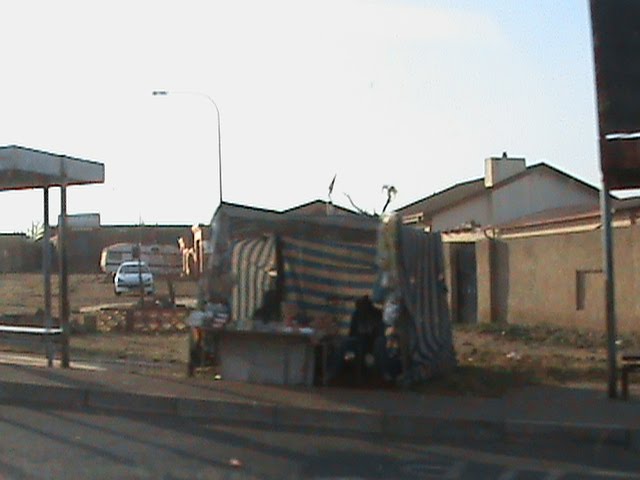
Orlando West, Soweto
Heard of Nelson Mandela, Desmond Tutu? They both lived on the only street in the world that has housed 2 Nobel Prize winners, Vilakasi street, Orlando West, in Soweto.


I stayed around the corner from Vilakasi street, at Lebo's backpackers. Well, I actually ended up sleeping at his grandmother's place, but that's another story.

Soweto is a township outside of Johannesburg. Millions of people live there, there are millionairres, and there are slums. It grew up as a shanty town when black people couldn't live in the city (like, only 16years ago). Soweto is the home of the struggle that ended apartheid.

Things an middle-class Australian may notice on coming to Orlando West, Soweto:

1. There are no footpaths so you have to walk on the road

2. The roads are full of potholes

3. There is rubbish everywhere

4. Everyone hangs out on the street

5. Everyone knows everyone's business. People live very closely

6. People have lost A LOT of loved ones

7. Some houses do not have running water or toilets. People are overcrowded. There are power shortages. But there are also mansions.
This is a shop. Not a mansion.

7. People drink beer from a carton. Apperently it tastes great (if you like rotten-custard-tasting beer, sure) and should be drunk wholeheartedlyby pregnant women (uh-huh)

8. And here is a number of a local guy who can help out with small penises

Monday, August 30, 2010

Today I witnessed mob justice or outta control violence

Today I saw 30 people beat up 2 young men.
Today I saw 10 cops torture these same 2 men.

These men were beaten up cos they held a knife to me and threatened to 'poke' me with it. I gave them what they wanted. My ipod, they wanted my ipod so much they were prepared to stab me for it. I do believe they would have stabbed me. So I gave it to them.

Yes - I was mugged in downtown Johannesburg.

I yelled at two men walking down the street to help me catch the theives and we ran. We ran and ran. So fast! They were dashing across freeways (I stayed on the side and yelled - too many cars!). Then more people came. And more people. Beggars from the street joined, security ran out from everywhere. It seemed that everyone was onto these 2 men.

There were like 30 people, all chasing these two guys. People came from nowhere and everywhere. It wasn't as if they were attempting to save this 'damsel in distress'. Instead it was like 'you can't do that shit here'.

And they caught them. All 30 of people caught those 2 young men. I was screaming at them to stop becasue they all stated beating them. I was taken away by security 'Shh, don't cry. Stop - it's all ok'. 'No! Are they hurting them? What are they doing to them?' 'Shh, it's all ok'.

I was taken to the Bramfontein poilce station. It was a caravan. A small caravan. The 2 boys were thrown in. One was bleeding from the head. The other had a black eye. I had to sit across from them and identify them. Although I thought I would never remeber them, it was as clear as day. I would never forget them.

The mob had confiscated a knife and my ipod earphones from them. Yet they insisted it wasn't them. 'You're lying!' I said 'You just threatened to stab me!' the police beat them - with their fists, their batons - all in that small caravan with me crying for them to stop - until they confessed. At one stage during the hour long 'confession' the police smothered one guy with a pillow so he couldn't breathe.

The police asked them why they had mugged me. They said that they were mugged the night before, and the theives had taken everything - their money, even one guy's pants (the shorts he was now wearing did look a little too big). One guy went and got my ipod that they had stashed in the bushes. The two young men apologised to me.

We were then taken to the police station in Hillbrow. When we got there the two men jumped out of the paddy waggon and came up to me, pleading for forgiveness. They were crying, brusied, bleeding. It was so horrible. They promised to never do it again, 'How do I know you won't do it again?', 'I swear on my Mother's grave'. They said they were students, get this - they're studying hospitality and tourism.

I dropped the charges. The police were nonplussed. I gave my muggers R10 each to get home. Otherwise they'd still be stuck needing to steal money to get home! If what they were saying is true.... I don't know.

Did I do the right thing? Within my ethical system, yes, I did. But it's so different here - justice works so differently here. Did I just let 2 muggers back on the streets? Or did I just show 2 young people a different way is possible? Or neither - does just nothing happen and everything just stay the same?

Tuesday, July 20, 2010

Witnessing real violence and minding our own business

What do we do when we witness violence against a stranger? Do we try to not get in the way? Do we let them sort it out themselves? Do we step in and risk our own safety? Is it just another reality performance?

A man was witnessed by the side of the road in Hahdorf, Adelaide, trying to kill his wife through beating her with a large stick several months ago. Today he has asked a local court if he can return to living with her, as he has just been kicked out of his temporary accomodation.

Do we let someone return to live with the person he has recently tried to kill?

The woman's defense has told the court she is happy for her husband to come back home. She is happy to live with her attempted-murderer. Becasue he is also her husband, her lover, and perhaps her friend. But are WE happy with that, as a society?

1. Do we try to protect woman who are beaten by their partners from their own wishes to be with their partners?

2. Do we approach the situation with an awareness of the impacts of intimate partner violence?

3. Do we value the woman's freedom to choose her own way of loving?

To complicate matters, the husband was captured and tortured in Iraq. Our war - we sent him there. But the wife has to deal with the consequences. I can't imagince the physical and emotional pain, and ther downright embarrassment of being beaten up on the side of a highway.

I can't help feeling like this woman, and yes, this man too, are like bottom-feeders. They are gulping up all the garbage of our society.

Do we sit back and watch? Do we take some repsonsiblity for others in our community?

What is the ethical responsibility of the witness?

Positive rape prevention?

Isn't it just better to focus on the good?

Can there be a politics of rape prevention that focuses on the good? Can methods of rape prevention seek to build up what is positive, or transformational, rather than focus directly on the problem?

Moira Carmody looks to ways to 'challenge the normalisation of intimate personal violence' through her sexual ethics program for young people.


Rather than looking at what is dangerous and what is safe, Carmody helps young people focus on what makes them feel good in relationships. Rather than impose a morality that insists women guard their virginity, the sexual ethics program explores different values with young people, and looks at some implications of these. The sexual ethics program only explicitly looks at rape towards the end of the program, before that focusing on desire and ethics.

I'm also thinking about what Catherine Waldby says in her paper destruction. Waldby talks about performing fantasies that challenge the rape script. The rape script inscribes men's bodies as dangerous, and women as having a 'vulnerable inner space'. Man give and women receive. So fantasies that challenge this script could involve the phallic woman, or the receptive man. Waldby is speaking specifically of sexual fantasies. She believes that sexual fantasies can be a method of rape prevention. Pretty positive huh?

It's such a movement from the old, yet still very popular of 'no means no' kinda campaign. the type that scares women into staying in their houses cos noone ever gets raped there. And the kind that advocates a kind of 'protector' mentality in men: as if they cannot be attacked.

I'm interested in Waldby's idea of fantasy as a way to challenge reality and then create new ones. I feel like we have to think things, imagine them, even play them out before we can do them.

Waldby also says that merely playing these games out with sex workers is not enough. It is not enough to strap on a dildo or be arse-fucked by a sex worker - we must do them in our everyday intimate relationships. Otherwise there is a kind of theme-park effect, in which the phallic woman and the receptive man contimnue to remain the Other. Reminds me of the Adelaide Fringe - does it really helps us Adelaideans embrace new ideas and artistic styles? Or is it just a visit to the freaks, like going to the circus to see the tatooed lady?

I think it does change us. It helps us see and feel safe in another way of being. It helps us to play and experiment, in safe ways, with other ways of doing things. It helps us to explore the other side without totally going there. I think it's really important.